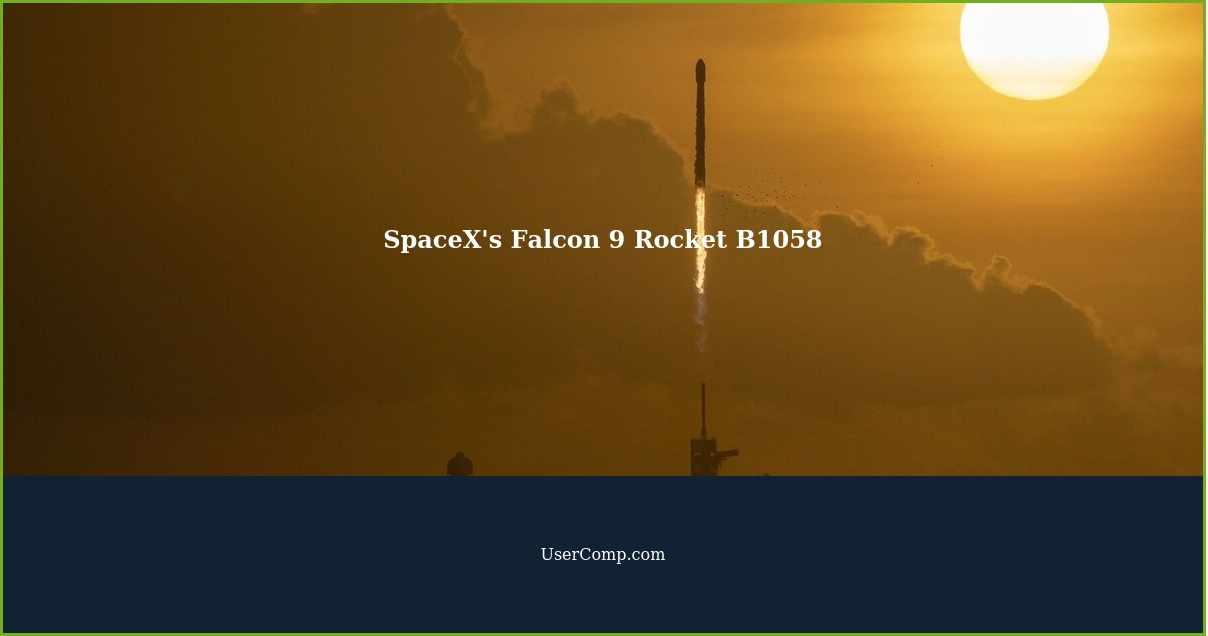
SpaceX's Falcon 9 Rocket Booster B1058 Reaches End of the Road
The historic Falcon 9 rocket booster B1058 has met its end after toppling over on a droneship in the Atlantic Ocean following its tenth launch and landing. The booster had been through strong winds in the aftermath of its launch and successful landing on the droneship, which was transporting it back to the Port of Cape Canaveral in the early hours of Sunday.
The news comes as a cold shower to SpaceX fans who had been hoping that B1058 would become the first booster to reach the milestone of 20 flights. The booster made its debut on May 30, 2020, during one of SpaceX's most significant missions: the launch of astronauts Bob Behnken and Doug Hurley, the first crewed mission for SpaceX and the first time that humans had launched from U.S. soil since 2011.
B1058 went on to break records, becoming the first SpaceX booster to complete 14 successful flights during a Starlink mission. Since then, it has set new records for the most flights by a single booster, reaching 19 flights before its final mission. The booster launched more than 860 satellites, carrying a total of 260 tons of cargo in just one and a half years.
The Falcon 9 Block 5 booster, of which B1058 was a part, was initially certified for ten missions. However, SpaceX later increased the booster's lifespan to 15 flights, and an in-depth evaluation of B1058 showed that it could fly at least 20 missions. Unlike the future Starship, the Falcon 9 is only partially reusable. SpaceX reuses the payload fairing (the cone-shaped structure that protects the satellites) and the first stage (a propulsion system with nine engines capable of returning to its launch site and landing vertically).
The newer Falcon 9 boosters have improved legs that can self-level and mitigate the problem of crosswinds, according to SpaceX. However, crosswinds are not a frequent problem. The boosters B1060, B1061, and B1062 have flown 17 times each and are ready to break B1058's record.
SpaceX's rockets have achieved over 250 successful landings, which is impressive, given the (low) number of failures.
The History of B1058
B1058 was one of SpaceX's most experienced boosters, having flown 19 missions since its debut on May 30, 2020. It was the booster that launched SpaceX's first crewed mission, carrying astronauts Bob Behnken and Doug Hurley to the International Space Station. The mission was a historic moment for SpaceX, as it marked the first time that humans had launched from U.S. soil since 2011.
After the successful crewed mission, B1058 went on to break records, becoming the first SpaceX booster to complete 14 successful flights during a Starlink mission. It set new records for the most flights by a single booster, reaching 19 flights before its final mission.
The Future of SpaceX's Boosters
While B1058 may have reached the end of its lifespan, SpaceX's newer boosters are more advanced and have improved legs that can self-level and mitigate the problem of crosswinds. The newer boosters, such as B1060, B1061, and B1062, have already flown 17 times each and are ready to break B1058's record.
SpaceX's Falcon 9 Block 5 booster was initially certified for ten missions, but SpaceX later increased the booster's lifespan to 15 flights. An in-depth evaluation of B1058 showed that it could fly at least 20 missions, demonstrating the potential for reusability in SpaceX's rockets.
Unlike the future Starship, the Falcon 9 is only partially reusable. SpaceX reuses the payload fairing (the cone-shaped structure that protects the satellites) and the first stage (a propulsion system with nine engines capable of returning to its launch site and landing vertically).
While the news of B1058's demise may be disappointing to SpaceX fans, it is a testament to the company's commitment to reusability and innovation. SpaceX's newer boosters are more advanced and have improved legs that can self-level and mitigate the problem of crosswinds. With the potential for reusability and innovation, SpaceX is paving the way for a more sustainable and cost-effective space industry.