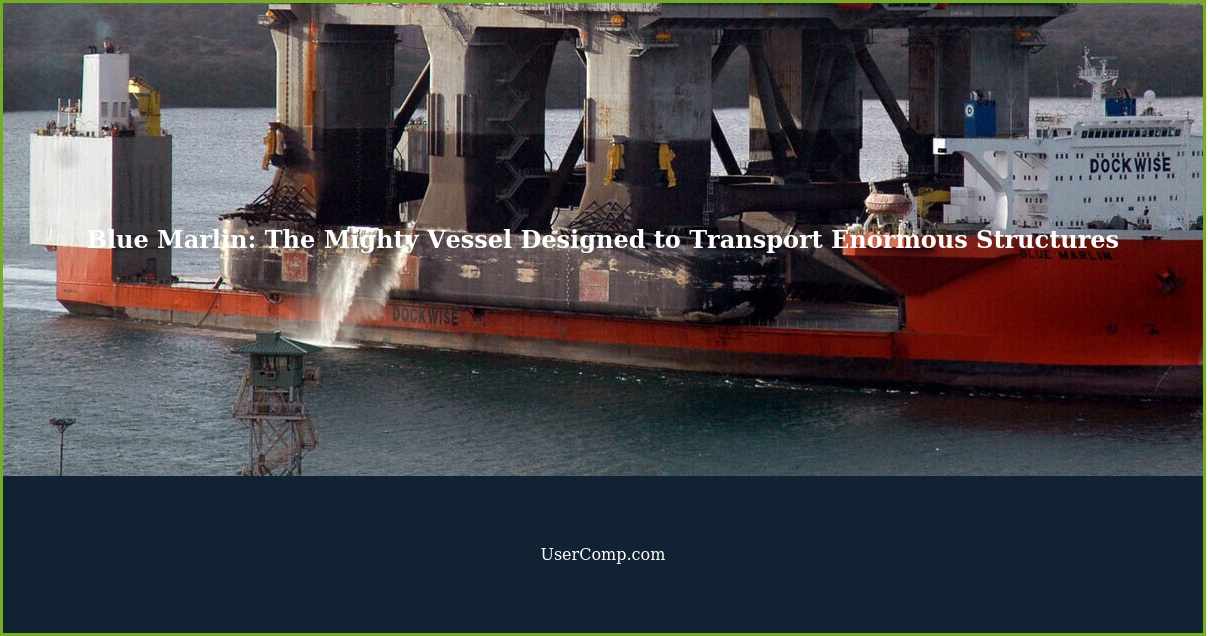
The Blue Marlin: A Heavy-Lift Vessel for Transporting Megastructures
When it comes to ships, we often think of vessels designed for transporting passengers, containers, cars, or gas. However, there is one ship that stands out from the rest - the Blue Marlin. This extraordinary vessel is specifically designed to transport other ships and megastructures across the oceans. From oil platforms to massive barges, the Blue Marlin can carry them all. It may sound unbelievable, but that's exactly what it was built for.
Unleashing the Beast
The Blue Marlin is owned by Boskalis, a Dutch company that acquired Dockwise in 2013. With an impressive track record in heavy maritime transport, Boskalis is no stranger to handling massive loads. The Blue Marlin itself is a true giant, measuring 224.8 meters in length, 63 meters in width, and with a draft of 13.3 meters, which can be extended to 28.4 meters when submerged. Its spacious deck covers an area of approximately 11,200 square meters (178.2x63 m) and can carry a deadweight of over 70,000 tons. With its cargo on board, the Blue Marlin can cruise at a speed of around 13 knots.
Not Your Average Ship
What makes the Blue Marlin truly remarkable is not just its size or speed, but how it manages to transport heavy loads like the HMAS Adelaide or the ALHD Camberra. Unlike traditional towing vessels, the Blue Marlin doesn't drag its cargo behind it. Instead, it ingeniously accommodates the load on its vast deck.
The key to the Blue Marlin's success lies in its design, which classifies it as a semi-submersible heavy-lift vessel (flo-flo, float-on float-off). This unique design allows it to partially submerge by filling its ballast tanks with water, making it easier to load and unload cargo on its enormous deck. The vessel's technical specifications reveal that it is equipped with four main ballast pumps, among other equipment.
For example, when the Adelaide was loaded in the waters of the Ría de Vigo in 2013, it required the assistance of mooring personnel, pilots, and tugboats. The Blue Marlin partially submerged its deck, positioned the Adelaide on it, and then resurfaced. To ensure the secure placement of the enormous structure, an iron and wooden "bed" was constructed for it.
The Adelaide is just one of the many heavy loads the Blue Marlin has transported. In the cover photo, taken in 2006, it can be seen entering Pearl Harbor, Hawaii, after completing a long journey from Texas to transport the Sea Based X-Band Radar (SBX) platform. It has also handled other structures, such as the 59,500-ton Thunder Horse oil platform.
A Family of Heavy-Lift Vessels
The Blue Marlin is not the only semi-submersible heavy-lift vessel of its kind. This concept, as noted by Va de Barcos, dates back decades and includes other classes such as the Ocean Servant or Super Servant. Boskalis' fleet also includes the White Marlin (72,000 tons) and the Black Marlin (57,200 tons), all dedicated to the transportation of heavy loads.
The Blue Marlin was built at the facilities of China Shipbuilding Corporation in Taiwan in 2000, as stated in its specifications, and was later remodeled in South Korea. Today, it roams the oceans as a true powerhouse, surpassing other marvels of naval engineering, such as the impressive offshore construction vessel, Pioneering Spirit.
Conclusion
The Blue Marlin is a testament to human engineering and innovation. Its ability to transport megastructures and ships across the oceans is truly awe-inspiring. With its unique semi-submersible design and impressive capabilities, it has become an essential tool in the field of heavy maritime transport. As technology continues to advance, we can only imagine what future marvels will be achieved in the world of naval engineering.