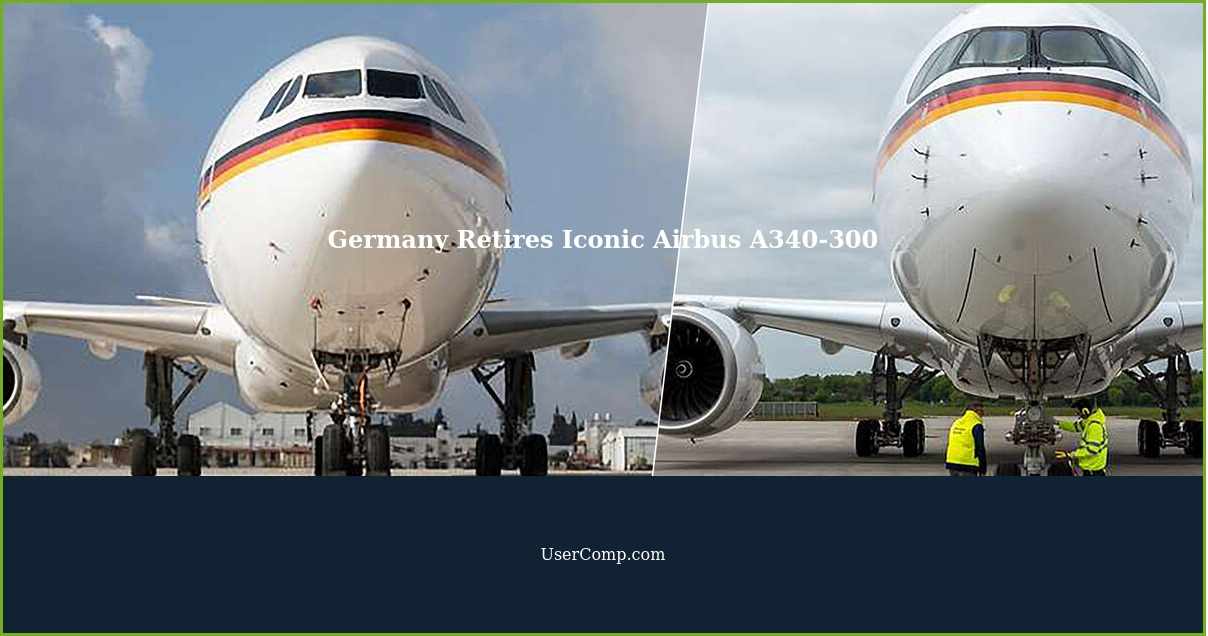
The Airbus A340-300, also known as 'Merkel One' due to its decade-long service as the transport for Chancellor Angela Merkel, is the German government's aircraft that is facing its final days, at least within the government's fleet. Germany currently has two of these aircraft in service, but they were both prematurely retired during the second quarter of this year. One of them, with registration number 16+02, was sold to a US-based company in September and is now registered under SkyWest Aviation with the matriculation N577TA. The other, 16+01, will be auctioned off by the federal agency Vebeg in mid-2024, although its history suggests that it won't be easy to sell.
The Airbus A340-300, which was manufactured in 1999 and delivered to Lufthansa in 2000, was acquired by the German government and assigned to the Air Force to convert into the new official aircraft for the nation after several years in commercial service. After undergoing a comprehensive technical review and interior conversion, the new aircraft entered service in 2011. It boasted an autonomy of 15,200 kilometers, enabling it to reach almost any part of the world without needing to refuel. Its interior featured a conference room, private areas, and space for 143 passengers.
However, in November 2018, during Chancellor Merkel's visit to the G20 summit in Hamburg, the aircraft suffered an electrical defect that forced the pilots to turn back and land in Cologne. Additionally, in August 2023, the same aircraft encountered problems with the flaps during a flight with the Minister of Foreign Affairs, Annalena Baerbock, on board. These incidents, along with others, prompted the German Air Force to retire the aircraft early.
As the German government prepares to retire the A340-300, it is unclear who the new aircraft's owner will be, especially if it will continue to serve a government airline. Nonetheless, the German Chancellor, Olaf Scholz, has a renewed fleet of aircraft at his disposal, including three Airbus A350-900s. Two of these aircraft have been in service since 2020, while the third is expected to be delivered in 2024. These new aircraft have several features that distinguish them from commercial aircraft, including their autonomy, which can reach up to 18,000 kilometers.
The A350-900s have several work and conference zones, as well as multi-purpose spaces. The aircraft can accommodate up to 133 passengers, including other government officials and delegations. The new A350-900s are 66.80 meters long, with a wingspan of 17.05 meters and a height of 64.75 meters. The aircraft's propellers are integrated with two Rolls-Royce TRENTXWB-84 engines, enabling it to reach a maximum speed of 960 km/h and a cruising speed of 910 km/h.
The German government has not yet announced when it will renew its fleet of aircraft, but when it placed the orders, announced by Ursula von der Leyen when she was the Minister of Defense, the cost of each unit was €302.9 million. This price would have increased with additional modifications to fulfill a new function.
When referring to the A350-900, we are talking about an aircraft with a wide body that emerged as a direct response to Boeing's 787 Dreamliner. Among its notable features are its aerodynamic design and more efficient engines. The first Airbus aircraft to be reinforced with carbon fiber composites in its structure.