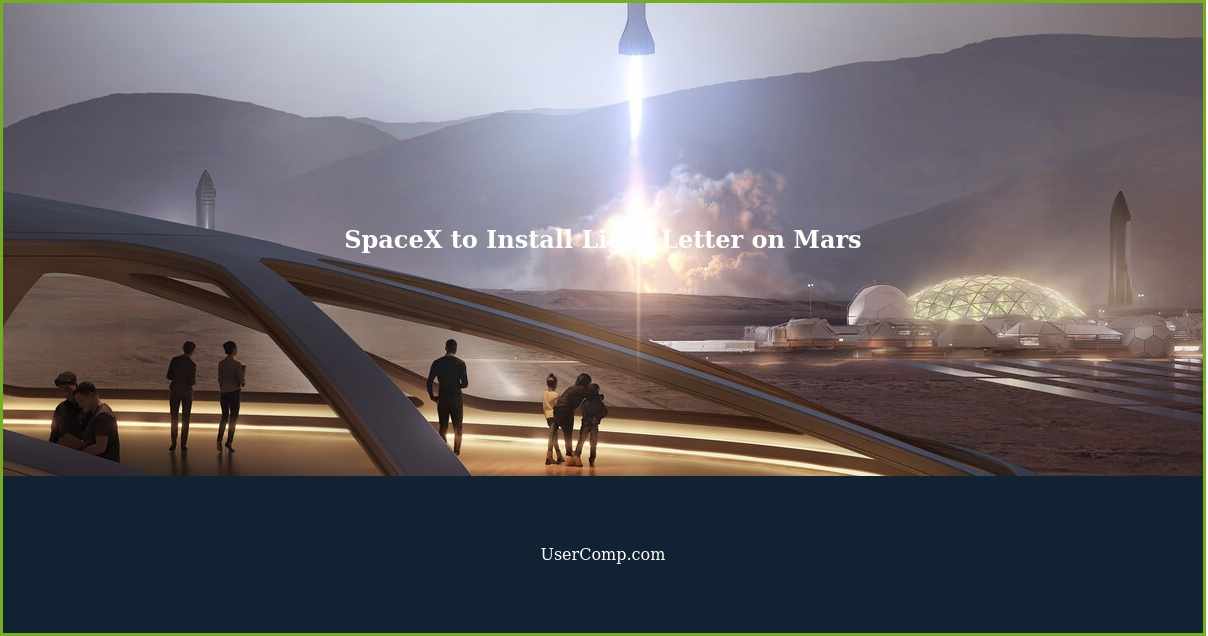
SpaceX's Bold Plan to Install a Giant Letter on the Mars Gateway
Elon Musk's ambitious plan to colonize Mars has taken a step forward with the announcement of the Starbase project in Texas, which includes the installation of a "Gateway to Mars" (Starbase). Musk founded SpaceX in 2002 with the goal of colonizing the red planet, and the company has achieved incredible things since then. However, Musk's most optimistic plan will require at least a thousand Starships and 20 more years of work.
Elon Musk's Mars Oasis
Before founding SpaceX, Musk briefly passed through the board of directors of the Mars Society, a non-profit organization that promotes the human conquest of Mars. It was during a plenary session of the association where Musk announced a project called Mars Oasis, which aimed to install a small greenhouse on Mars to reactivate public interest in Martian exploration. Musk's ambition evolved over time, and the idea of growing plants on Mars turned into something much more complex: transforming humanity into a multiplanetary species capable of surviving a catastrophe on Earth. From a more pragmatic point of view, Musk's goal is to create the necessary infrastructure for a self-sustaining human settlement on Mars.
"I can make my own rockets to go to Mars," Musk must have thought, and 20 years later, that's precisely what he's doing with the Starship.
The Starship Program
Although the name may change over the years, the long-term plan of the Starship program remains the same:
- A massive, fully reusable spacecraft capable of launching more than 100 tons of payload into space at a minimum cost.
- A fleet of these spacecraft, financed by public and private funds, capable of transporting dozens of people to Mars to build a crewed base.
- Thousands of these spacecraft flying to Mars every time the planets align, building a self-sufficient city of one million inhabitants.
SpaceX still needs to prove the first point, but Musk's plan is not only ambitious, but also optimistic. In 2019, Musk estimated that it would take 1,000 Starships to build a sustainable city on Mars in 20 years. He also estimated the cost of each launch at $2 million, an absurdly low amount for industry standards. Launching a Falcon Heavy, SpaceX's most powerful rocket in service, costs 50 times more.
In 2020, Musk provided additional calculations. The goal of Starship is to fly three times a day, one thousand times a year, launching a megaton of payload into space per decade through ten Starships. "If we build 100 Starships a year, we will have 1,000 in 10 years, launching one megaton per year," Musk said. "Approximately 100,000 people per synchronized orbital Tierra-Marte window."
The Mars launch windows open every 26 months, taking advantage of Mars' proximity to Earth. Musk believes that if launches begin in 2028, the Martian city of one million inhabitants could materialize in just 22 years, in 2050.
An Optimistic Vision
Musk's vision is undoubtedly optimistic, but there's something that can't be denied: Musk's goal has become SpaceX's goal. The company is now valued at $180 billion, and the Starship exists. We have seen it reach space.
Elon Musk has confirmed a second version of Starship: what do we know about Starship V2?
SpaceX's Starship spacecraft has undergone significant changes since its inception, with the latest version, Starship V2, being the most advanced yet. In this article, we will explore what we know about Starship V2, its design, and its capabilities.
Design and Capabilities
Starship V2 is a fully reusable spacecraft designed to carry up to 100 people to Mars, the Moon, and other destinations in space. It is 50 meters tall and has a diameter of 9 meters. The spacecraft is made of stainless steel, which is lightweight and can withstand high temperatures.
Starship V2 has a total of six Raptor engines, which provide a thrust of 11,000 kilonewtons, enabling the spacecraft to reach orbit. The Raptor engines use liquid methane and liquid oxygen as fuel, which is more efficient and environmentally friendly than traditional rocket fuels.
The spacecraft has a heat shield to protect it during reentry into Earth's atmosphere, and it can land vertically using its Raptor engines. Starship V2 can also be refueled in orbit, which will enable it to carry out long-duration missions to Mars and other destinations.
Testing and Development
SpaceX has been testing Starship prototypes since 2019, with several successful flights and landings. The latest prototype, Starship SN15, flew to an altitude of 10 kilometers and landed vertically in May 2021. SpaceX is currently building a new prototype, Starship SN20, which will be the first to fly with the new Raptor engines.
SpaceX is also building a new production facility in Texas, where it plans to manufacture Starship and its Super Heavy booster. The facility will have the capacity to produce several Starships per month, enabling SpaceX to accelerate the development and testing of the spacecraft.