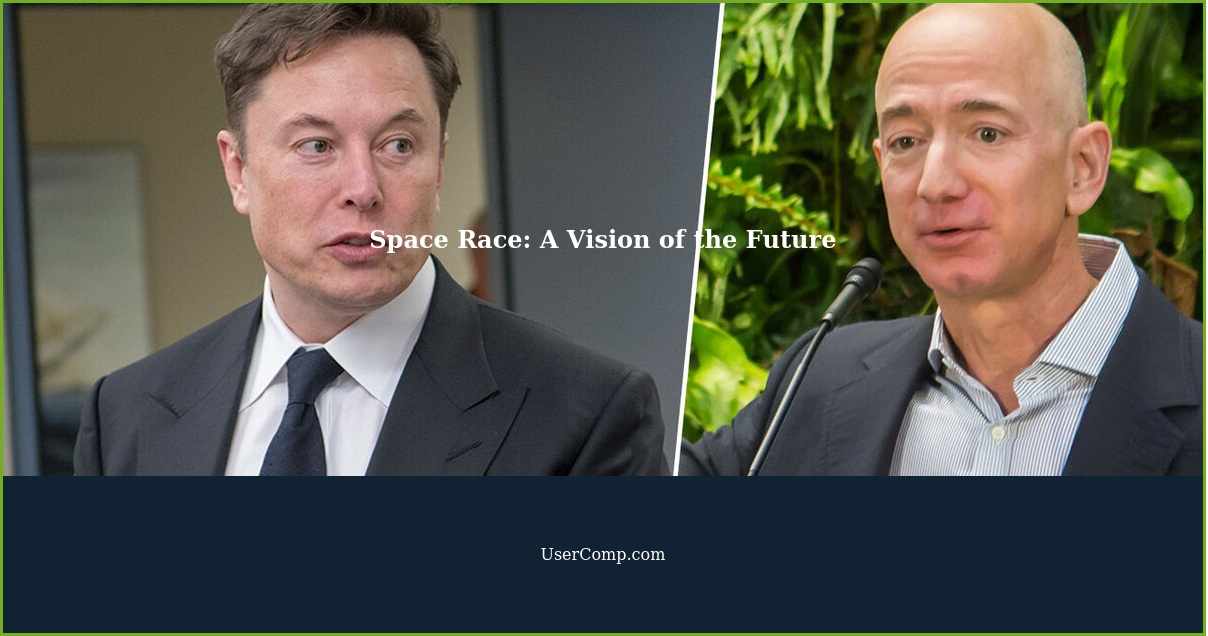
Rivalry Between Elon Musk and Jeff Bezos in the Private Space Race
The rivalry between Elon Musk and Jeff Bezos is at its peak in the private space race, with SpaceX and Blue Origin competing to obtain contracts with NASA and to achieve a space elevator in the shortest possible time and at the lowest cost. However, an interview with the billionaire founder of Amazon on the Lex Fridman podcast has revealed that both leaders share a vision for the future of humanity: an interplanetary human race.
Jeff Bezos' Conciliatory Tone Towards Elon Musk
In response to the interviewer's questions, Bezos responded with a conciliatory tone regarding the supposed rivalry between the two. "I don't really know Elon very well. I mean, I know his public persona, but you can't know anyone based on their public persona. It's impossible. You can think you know them, but I guarantee you don't. You probably know Elon much better than I do, Lex [Lex Fridman has interviewed him several times]. But judging by the results, he must be a very capable leader. There's no way you can run Tesla and SpaceX without being a capable leader. It's impossible."
The conciliatory tone of Bezos, and the one shown by Elon Musk when talking about Bezos' qualities as a person and entrepreneur, seems to indicate that both billionaires have put their axes of war aside after the legal battle between Blue Origin and SpaceX over their fight to secure NASA's space projects.
A Shared Vision for the Future of Humanity
Despite their differences over the competitiveness of their companies, both Elon Musk and Jeff Bezos share a vision: the future of humanity lies in space. "I would like to see a trillion humans living throughout the solar system. If we have a trillion humans, we would have, at a certain point, thousands of Mozarts and thousands of Einsteins. We would have a solar system filled with life, intelligence, and energy. We would easily guarantee the survival of our civilization with all the resources of the solar system. The only way to make that vision a reality is in large space stations. Planetary surfaces are too small," Bezos declared in his interview.
Elon Musk also maintains the vision of an interplanetary humanity. In his biography, Musk states, "It's like a tiny candle in the vast dark universe, and humanity's obligation is to keep it from going out."
In an intervention at the Vivatech innovation fair, Musk jokingly confessed that since he took over SpaceX, he had not yet seen any extraterrestrials. Then, in a more serious tone, Musk stated that since the only evidence of intelligent life is on Earth, humanity has an obligation to preserve it. Therefore, making a multiplanetary life system possible has become SpaceX's main goal.
In conclusion, despite the rivalry and competition between Elon Musk and Jeff Bezos in the private space race, both billionaires share a common vision for the future of humanity: an interplanetary human race that expands throughout the solar system. Their conciliatory tones and mutual respect indicate that they have put aside personal rivalries and are focused on advancing the exploration and colonization of space for the benefit of all mankind.