The Changing Relationship Between the US and China in Space Exploration
The relationship between the United States and China has undergone significant changes in the past decade. This is particularly evident in the realm of commerce, with increasingly aggressive trade blockades and sanctions. However, similar dynamics have also played out in the field of scientific cooperation.
Since 2011, the United States has prohibited NASA from collaborating with China on space-related matters. In turn, China has refrained from signing any agreements on scientific and technological cooperation since 2018. The two countries' respective space agencies have been at odds with each other. Nevertheless, China's space administration possesses something that the United States would like to have: samples from one of the Moon's youngest regions, which were brought back to Earth in 2020 by the Chang'e 5 lunar mission.
The Controversy Surrounding Lunar Samples
On November 29th, NASA made an exceptional move by opening up a channel of collaboration with China's space administration. In an internal message, the American agency granted permission to its researchers to request samples of lunar regolith and rocks collected by the Chang'e 5 mission from their Chinese counterparts.
A 2011 law known as the Wolf Amendment prohibits NASA from collaborating with China on space-related matters without authorization from the United States Congress. NASA has notified Congress of its intentions and has provided instructions to its researchers on how to request the samples.
Understanding the Wolf Amendment
The law, promoted in 2011 by Republican Congressman Frank Wolf, prohibits the use of federal funds for any space-related activity involving direct contact with Chinese government officials or their subsidiaries. The law was introduced to prevent China from participating in the International Space Station. However, China has since built its own space station, called Tiangong, which features two laboratories and is permanently inhabited.
Why Chinese Samples Are Important
The significance of the Chinese samples is well explained in the message sent by NASA to its researchers. As cited by Eureka, "The Chang'e 5 samples originate from regions of the Moon that have not yet been studied by NASA, and they are expected to provide new and valuable scientific insights into the Moon's geological history."
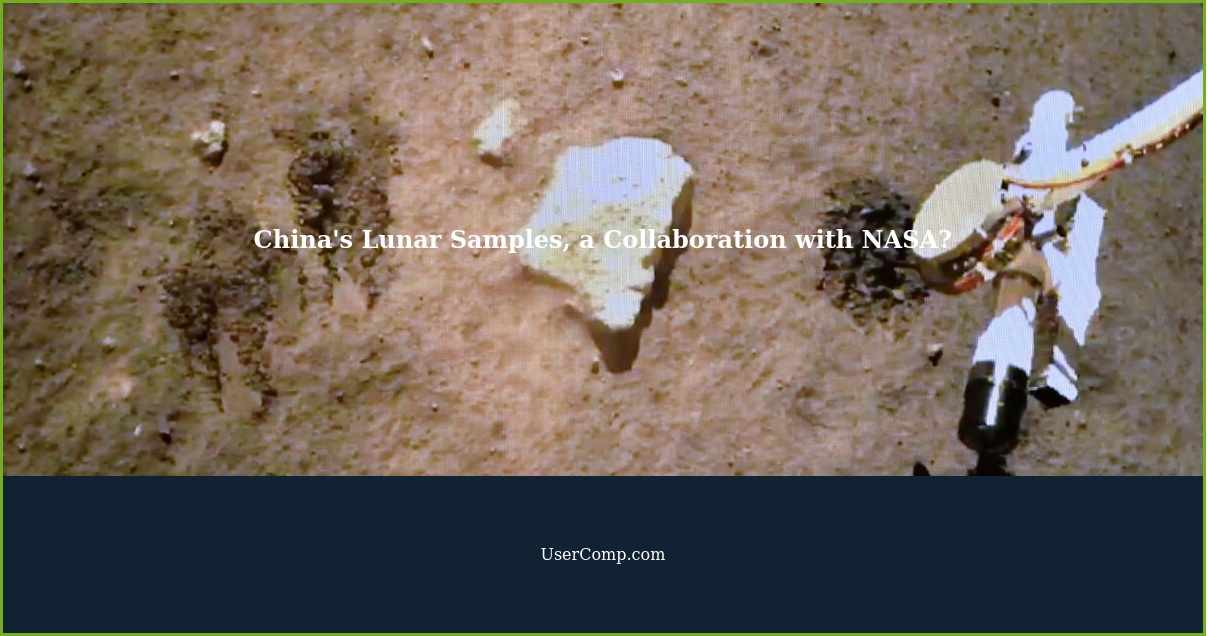
Although the Moon is vast, the samples retrieved by American and Soviet missions 50 years ago come from a small part of the Moon's center and northeast. The Chang'e 5 mission, carried out by China's space administration, landed in a geologically young area of the Moon and collected 1731 grams of regolith and rocks using a shovel and drill.
Scientific Discoveries from the Lunar Rocks
Over 70 scientific articles have been published based on the samples collected. Since Chang'e 5 landed in one of the Moon's youngest basalt regions, Chinese researchers were able to refine the Moon's estimated age (the average age of the samples is 1.963 billion years, with a margin of error of 57 million years).
Other studies have revealed that the Moon was still volcanically active 2 billion years ago. The decomposition of the samples also led to the detection of water and a new mineral that has been named Changesite-(Y).
What China Would Gain from Collaborating with the United States
It is not confirmed whether China will send samples to NASA researchers, but the country's space administration is open to requests from any international team until December 22nd. While some of China's public opinion is against this collaboration, sending samples to NASA would be a clear diplomatic, image, and public relations victory. It would also be a victory for science because NASA possesses unique instruments and can compare the samples with those from the Apollo missions.
What the United States Could Offer in Return
An exchange of samples could occur, similar to the one between China and Russia (1.5 grams of fresh samples from Chang'e 5 in exchange for 1.5 grams brought back by the Luna 16 probe in 1970). The United States has a large number of samples from the Apollo missions to negotiate with, but NASA has already ruled out an exchange in 2021. It is likely that China will not request anything in return because the fact that NASA is interested is already a victory in itself.
Perhaps most importantly, this exception opens the door to long-term collaboration. NASA does not rule it out, provided that China's space administration becomes more transparent in its actions. "Cooperation with China depends on China," said Bill Nelson, NASA Administrator, at a congress in Paris last year. At the same time, Nelson is reluctant to repeal the Wolf Amendment.
What is clear is that long-term collaboration would be beneficial for NASA because China's space program is progressing rapidly. China has set its sights on retrieving samples from the far side of the Moon in 2024 with the Chang'e 6 mission.