Articles about industry | UserComp.com
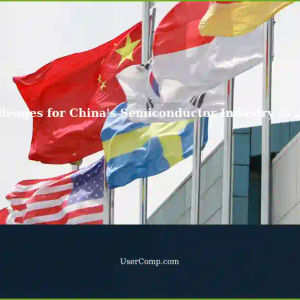
China's Semiconductor Industry Faces Challenges in 2023
China's semiconductor industry faced numerous challenges in 2023, including the US and its allies attempting to hinder China's advancement in leading-edge circuit designs to impede its military capabilities. However, this doesn't mean China's chip manufacturers have been left behind. In fact, the global chip market saw a significant decline in 2023 due to a one-year pandemic delay, affecting all chipmakers, including Intel, Apple, Qualcomm, Texas Instruments, AMD, Samsung Electronics, SK Hynix, SMIC, and others. The demand from their clients has been reduced, with September 2023 distributing 24% fewer chips than the same period in 2022. The global chip production capacity in China increased by 6.9% in 2023 compared to 2022, according to China's National Statistics Office. So, how is it possible that China's chip industry had a significant improvement in 2023? The answer lies in the fact that the global chip production capacity increased by 6.9% in 2023 compared to 2022, according to China's National Statistics Office. However, to understand the situation in detail, we need to dig deeper. In November 2023, Shen Bo, the president of ASML's Chinese branch, assured that the demand for equipment from China was still strong. Interestingly, the demand from other countries was also significant, with ASML, Tokyo Electron, and Canon Nikon being reliant on Chinese chipmakers to maintain their development pace and compete with foreign competitors, such as TSMC, Intel, and Samsung. The global chip production capacity increased by 6.9% in 2023 compared to 2022, but the situation is more complex. China is not the only solution. China will also face challenges in the medium term in strengthening its semiconductor industry by relying on the US and other countries for advanced equipment and technology.
Read More
PC1 Sending CAD Files to Networked Mill via USB for Dental Industry
The dental industry is adopting advanced technology to improve patient experience and efficiency. In this setup, PC1 sends CAD files to a networked mill connected via USB for milling. In this article, we discuss the process of setting up this connection.
Read More
US-China Rivalry Intensifies, Posing New Challenges for Semiconductor Industry
The US-China rivalry has reached new heights, with the US government recognizing China's capability and resources to dispute US leadership globally. The US has imposed restrictive measures on technology transfers to China, targeting the semiconductor industry. China is adapting to these challenges by investing in its domestic chip industry and reinforcing chip production with mature technologies. The US must carefully consider its next steps to avoid further escalation of the conflict and protect its business interests in China.
Read More
China's Dominance in Rare Earth Industries Faces Challenges
China has long been the world's leading producer of rare earth elements, accounting for over 90% of global production. However, in 2022, its market share dropped to 70%, due to increased production in countries like Australia, Vietnam, and Myanmar. These elements have unique properties and are valuable in various industries, including electronics and renewable energy. China controls 90% of the global processing industry for rare earth elements, and recent restrictions on technology exports may further strengthen its position. However, countries like the US, Europe, Japan, and Australia are looking for ways to reduce their dependence on China for these critical materials, either by finding alternatives or forging alliances to compete with China's dominance.
Read More
Sony's PlayStation 5 Outsells Microsoft's Xbox Series in Console Sales
Sony's PlayStation 5 has sold over 50 million units, surpassing Microsoft's Xbox Series sales. According to recent data, the combined sales of Xbox Series X/S reached 24.3 million units by October 2023, still far behind the PS5. The two companies have adopted different strategies to succeed in the gaming market, with Microsoft focusing on entertainment beyond the console and Sony relying on high-profile launches and its gaming platform.
Read More
Circular Queue in Python: Use Cases in Industry
Circular Queue in Python: Use Cases in Industry. Learn how to use Python's built-in circular queue and its various use cases in industry.
Read More