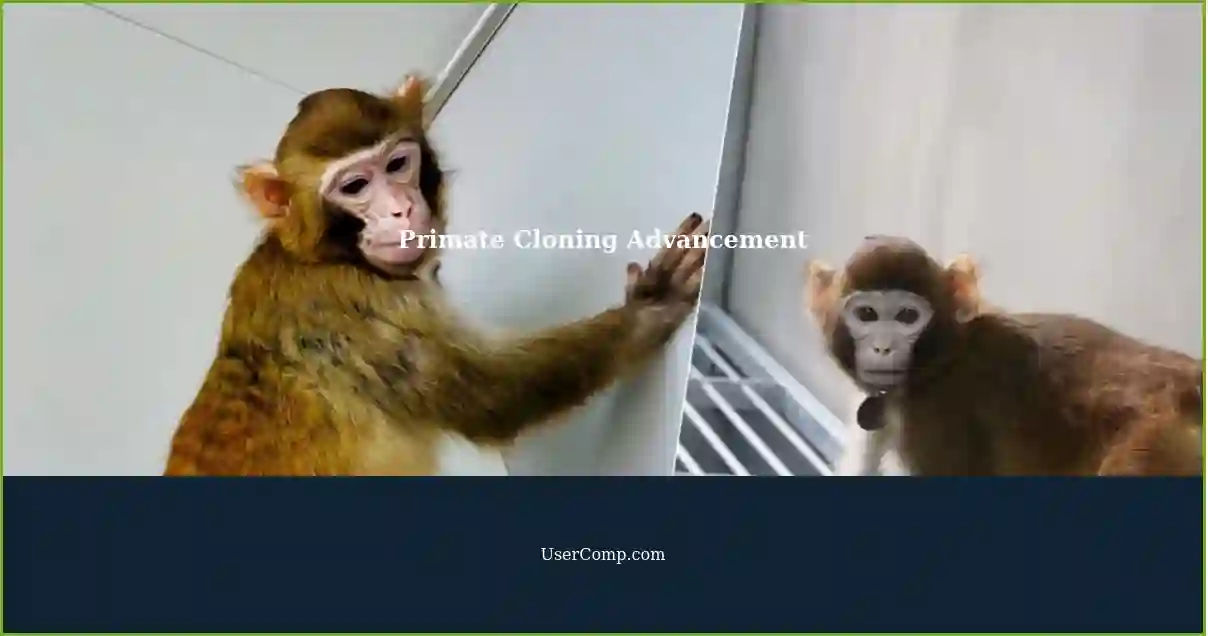
Significant Progress in Primate Cloning: Macaque Monkey Cloned Successfully
Over the last 30 years, cloning technology has made great strides in the field of animal cloning for research purposes. However, technology has also been quite revolutionary in other aspects. Recently, a team of scientists from the Chinese Academy of Sciences in Shanghai announced a significant breakthrough in the development of this technology.
Monkey Cloning: A New Horizon
This marks the first time a primate has been cloned, according to statements made to Science Media Centre Spain by Lluís Montoliu, a researcher at the Centro Nacional de Biotecnología (CNB-CSIC) and CIBERER-ISCIII. In 2018, the same team cloned a macaque monkey (Macaca fascicularis). The problem with that occasion was that the efficiency of the process was only 1.5%, which was a far cry from the success rate obtained with Dolly, the sheep cloned in 1996. However, five years after that first cloning attempt, this team was able to repeat their success with another species.
SCNT: Overcoming Challenges
In parallel with cloning, researchers analyzed the first embryonic data with epigenetic information from blastocysts, comparing those formed by in vitro fertilization with those cloned using somatic cell nuclear transfer (SCNT). They tried to find errors in the access to genetic information in the cloned embryos' placenta, which developed from the cloned cells, and from the analogous blastocyst. They were able to introduce changes in the epigenetic state of these embryos to prevent potential complications.
A New Leap Forward
The details of this process were published in an article in the journal Nature Communications. Since the first cloning of a sheep, there have been numerous cloning successes with various mammalian species. Dolly opened the door to cloning pigs, goats, cows, cats, horses, and even mule deer and red deer. But cloning humans still remains in the realm of the speculative, science fiction, and ethical debates: we are still far from cloning people.
As Montoliu explains, "it is difficult to achieve success with these experiments, with low efficiencies, and to justify cloning humans." In addition to the limitations of the technology itself and the lack of success, there are also ethical motivations that prevent us from getting closer to human cloning, as Montoliu mentions: the impossibility of performing such experiments in the European context, and the current legislation restricting research on non-human primates for diseases.
The Future of Cloning
Despite these challenges, the team's success in cloning a macaque monkey opens up new possibilities for the future of cloning research. The potential applications of this technology in fields such as biomedicine, agriculture, and conservation are vast. Only time will tell what the future holds for this fascinating and complex area of research.