The Changing Landscape of Chinese E-commerce: PDD Holdings Challenges Alibaba's Dominance
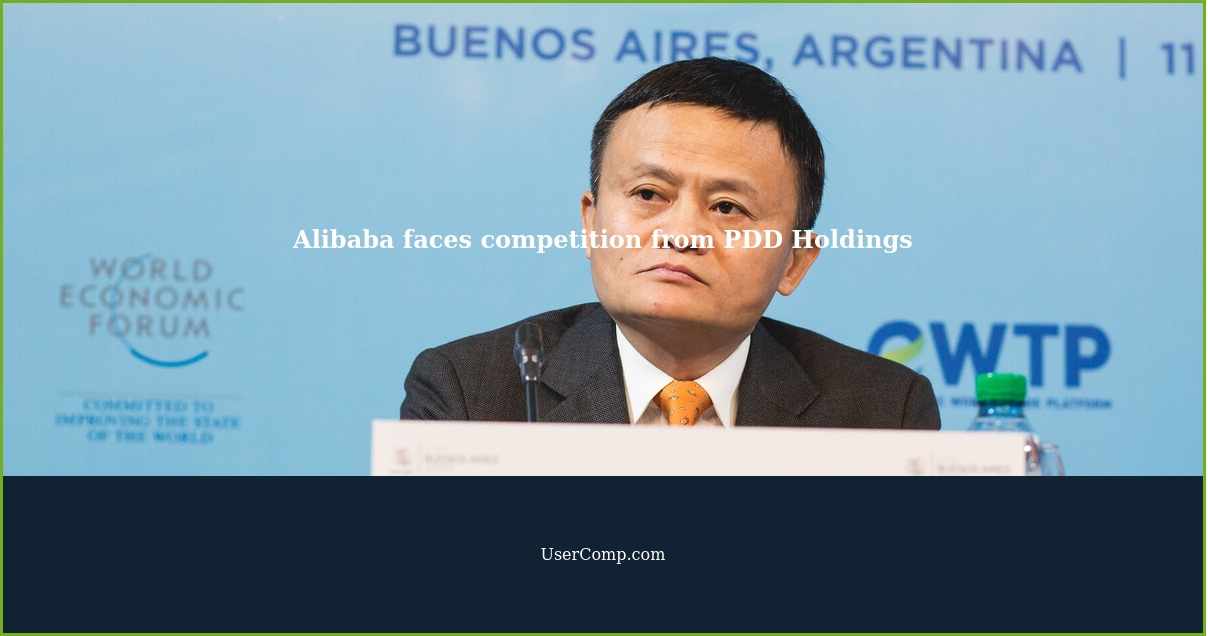
The Chinese online commerce sector is undergoing changes that were once unthinkable. In a surprising turn of events, the powerful e-commerce giant Alibaba, which many considered China's top candidate to become a trillion-dollar multinational, is facing a dangerous challenge from the younger Chinese firm PDD Holdings. In fact, PDD has already surpassed Alibaba in market valuation, albeit temporarily. The intense competition from PDD has led The Wall Street Journal to discuss changes in the balance of power in Chinese e-commerce, and even Jack Ma, who has been out of the spotlight for several years, has stepped forward to congratulate his rivals and rally his employees, stating that Alibaba needs to "correct its course."
The Rise of PDD Holdings
According to Dave Sebastian of TWSJ, there are "changes" in the "balance of power" in the massive Chinese e-commerce sector, and the data indicates that he may be onto something. Just a few days ago, PDD Holdings reached a market valuation of $196 billion, a significant figure for a company that is less than ten years old. This achievement becomes even more noteworthy when compared to the rest of the sector, especially considering that PDD Holdings surpassed Alibaba, a heavyweight in e-commerce, which was inconceivable not too long ago.
Other economic media outlets, such as the Financial Times, Bloomberg, and The Business Times, also reported on this milestone. After a 4% increase in its US operations, PDD came close to a market valuation of $196 billion, surpassing Alibaba's $190 billion at the close of the New York Stock Exchange. Of course, these values are subject to fluctuations, but they provide a clear picture of the "changes in balance" that Dave Sebastian warns about and the pressure Alibaba feels to maintain its position as the king of Chinese online commerce in terms of valuation.
Who is PDD Holdings?
PDD Holdings may not be as well-known as Alibaba, and its founder and former CEO, Colin Huang, may not have reached the same level of popularity as Jack Ma, Alibaba's co-founder. However, PDD Holdings has been making a strong impact in the e-commerce sector for several years. The company was founded in 2015 and has become a powerful group with a market capitalization that is currently close to $185 billion, according to data collected on its website.
PDD Holdings is the parent company of Pinduoduo, which started as an agricultural platform and expanded to reach 900 million users, according to its estimates. It is also the creator of Temu, an e-commerce service that aims to compete with Amazon and has been available in Spain since April.
Although PDD Holdings is only eight years old, the company has shown ambition and a desire to expand internationally in recent months. In May, CNBC reported that PDD Holdings had relocated its "main executive offices" from Shanghai to Dublin, and its launch of Temu in the US market was a grand affair, including an announcement during the Super Bowl. Its app became the most downloaded app in the entire US, surpassing Amazon and Walmart. According to data from Sensor Tower, its expansion into Europe allowed it to enter the global "Top 10" apps list.
A Look at Their Performance
We don't have to go back months to get an idea of how things are going for PDD Holdings. Its aggressive business strategy has allowed the company to see a 94% year-on-year increase in revenue, reaching CNY 68.84 billion (approximately $9.6 billion) in the July-September quarter. Its stock has skyrocketed from $62 to $143 in recent months, and analysts consulted by Reuters believe that Temu will generate more than $16 billion in revenue this fiscal year.
All of this has been driven by PDD's low-cost pricing strategy, which allows customers to buy headphones for as little as $4, swimsuits for $6, smartwatches for $17, or hoodies for $15. In fact, their successful US launch slogan was "Shop Like a Billionaire." Their strategy of ultra-low prices is complemented by a wide range of products, ranging from clothing to electronics and furniture, as well as an equally aggressive marketing campaign.
The Situation at Alibaba
PDD's ability to challenge Alibaba is due to its expansion strategy, but also to the weaknesses of the giant founded by Jack Ma. Alibaba's stock has experienced a 76% decline from its 2020 peak. In recent years, Alibaba has had to contend with increasing competition, both in the e-commerce field and in other areas. Its cloud services division, which experienced significant growth, is now facing rivals like Huawei.
Jack Ma's Call to Action
Perhaps the most evident sign of the changes in the sector and the increasingly fierce competition that Alibaba faces is the fact that its co-founder, Jack Ma, has stepped forward to encourage the company to "correct its course." Ma stepped down as executive chairman in 2019 and has maintained a low profile since his critical comments in 2020 sparked the anger of Chinese regulators. However, he has decided to speak up in an internal memo reported by Nikkei Asia.
"I believe that everyone at Alibaba is watching and listening today," says Jack Ma. "I am even more certain that Alibaba will transform and change. All great companies are born in the winter. The era of AI-driven e-commerce has just begun, which represents both opportunities and challenges for everyone."
Cover image: World Trade Organization (Flickr)